Most plugins that would benefit from a Minn surface keep their data in a custom database table: form entries, email logs, redirects, queue rows. Core REST knows nothing about those tables, so the integration is two parts:
- a REST shim — a few small routes that translate "rows in my table" into JSON, and
- a surface descriptor — pure data telling Minn how to render it.
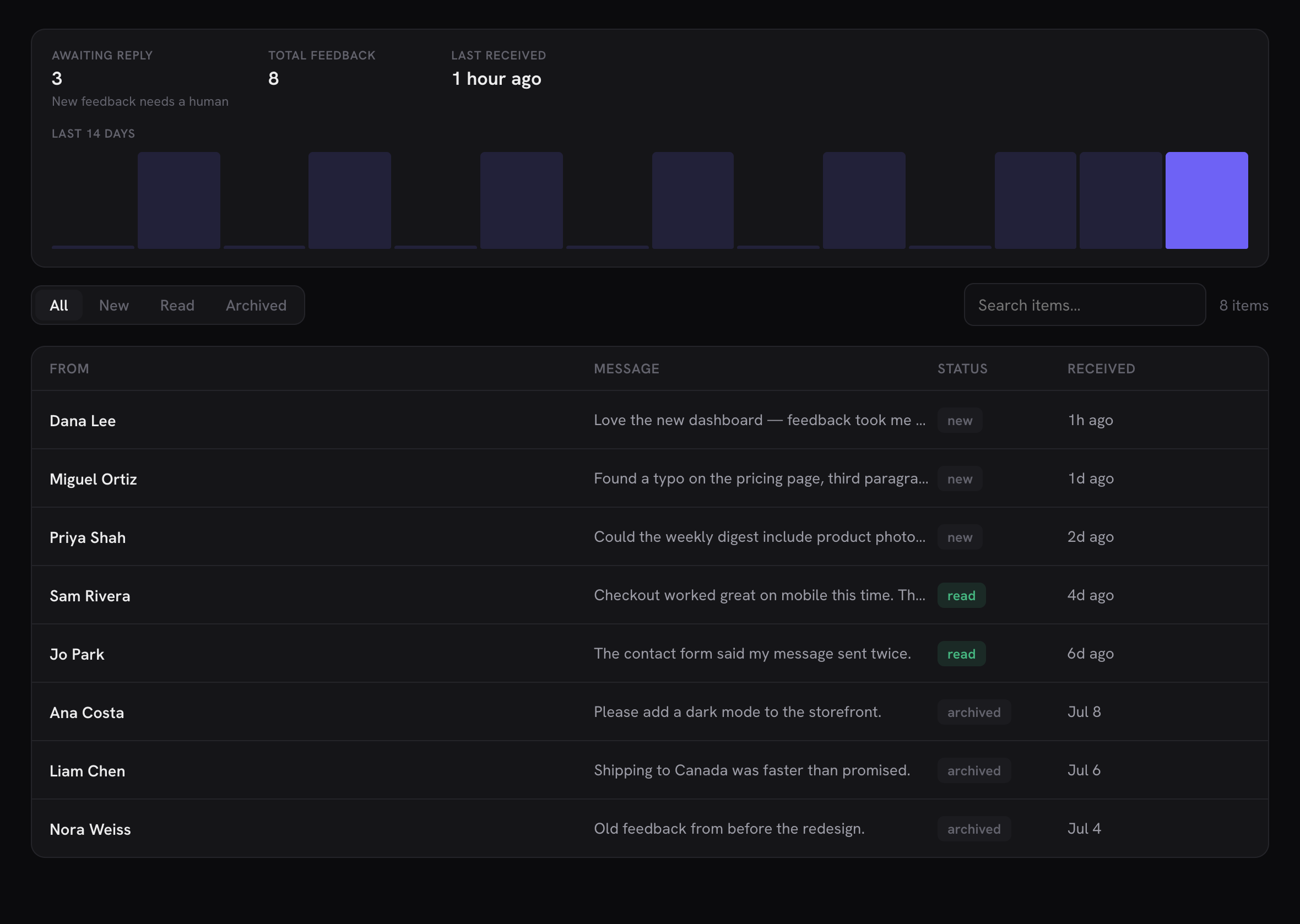
This walkthrough builds both for a fictional plugin, start to finish. The finished code is a real, working plugin you can copy: docs/examples/minn-example-adapter/. Drop it into wp-content/plugins/, activate it next to Minn Admin, and a Feedback view appears in the sidebar with a status card, tabs, search, a detail modal and row actions. Every section below is numbered to match the comments in that file. (It is also exercised by Minn's own test suite, tests/example-adapter.test.js, so if the contract ever changes, the example breaks in CI before it breaks under you.)
The fiction: Campfire collects visitor feedback into {prefix}campfire_feedback: id, name, email, message, a status (new / read / archived), and a UTC created_at.
Step 0 — where the code lives
One file inside your own plugin, loaded unconditionally:
require_once __DIR__ . '/includes/minn-admin.php';Everything in it is add_filter / register_rest_route calls: with Minn absent the filter never fires and the routes just sit there: a free no-op. No class_exists( 'Minn_Admin' ) guard needed. (The example plugin is single-file only because it's a tutorial.)
Step 1 — the data (one decision that matters)
The table itself is whatever your plugin already has. The one choice worth making deliberately: store timestamps in UTC (gmdate, not current_time). Minn renders relative times ("2 hours ago") in the visitor's timezone, and it needs to know what it's parsing. Bare datetimes are assumed site-local; a utc: true flag on the column (step 4) declares otherwise. The classic shim bug is storing UTC and letting it render as site-local: every timestamp shifts by the site's offset and nobody notices until a log entry appears to come from the future.
Step 2 — one capability helper
function campfire_can() {
	return current_user_can( 'moderate_comments' );
}
Pick the capability for the data, not for the screen. These rows hold visitor names, email addresses and message bodies, so the bar is the one you would set for reading comments. edit_posts would have handed the whole inbox to every Contributor. A surface is only ever as private as its capability, and the default in an example is what gets copied.
Minn checks the descriptor's cap before the surface exists in the app at all, but that is UI gating, a convenience. Your routes' own permission_callback is the boundary. Centralize the answer in one function so the two can never disagree, and swap the body for your plugin's real capability model (a granular cap, an option-driven role check, your own resolver). If your plugin has its own access settings ("only these roles may see submissions"), route through them here, the way the bundled WP Activity Log adapter routes through that plugin's own Settings_Helper::current_user_can().
Step 3 — the REST shim
Five small routes. The shapes Minn consumes:
| Route | Returns |
|---|---|
GET /feedback | { "items": [...], "total": 123 } — the list |
GET /feedback/{id} | one item — the detail modal |
POST /feedback/{id}/read | { "message": "Marked as read" } — an action |
POST /feedback/{id}/archive | same shape — a second action |
GET /feedback/status | the status card model |
Rules that keep a shim safe, all visible in the example file:
- Every route declares
permission_callback. Never__return_truefor private data. (Minn's System page flags plugins that skip this.) - Every query goes through
$wpdb->prepare. The search input is a visitor-typed string headed into SQL:esc_like+ placeholders, no exceptions. - Cap
per_page. Minn asks for 25; a hand-crafted request should not be able to ask for a million. - Never
unserialize()stored blobs. Not needed for Campfire, but the rule that bites real log tables: if an old row holds a PHP-serialized value, parse it with a regex orjson_decode; a crafted blob must never reachunserialize().
The list route reads three inputs Minn sends: page (plus whatever your pageQuery template names, here per_page), the active tab's value (here the status param, declared in step 4), and the debounced search term. It answers { items, total }; the descriptor's itemsKey / totalKey point Minn at both. Standard WP-style collections (plain array + X-WP-Total header) skip those two keys entirely.
Shape each row in one function (campfire_item() in the example) so the list and detail routes can never drift apart.
Action routes do their one write through your plugin's own code path and may return { "message": "…" }; that string replaces Minn's default "⟨label⟩ — done" toast, which is the honest channel when the outcome needs more words than the button label promised.
The status route returns display-ready strings: Minn renders the card, your server does the formatting (counts, human_time_diff, currency, whatever). An optional chart key draws a daily bar series in the same visual language as Minn's Overview charts.
Step 4 — the descriptor
Pure data on one filter. No callbacks reach the client (setup callables are evaluated server-side), no JavaScript ships, and Minn escapes every value it renders; never pre-escape.
add_filter( 'minn_admin_surfaces', 'campfire_surface' );Walking the choices in the example's descriptor:
cap— mirrorscampfire_can()(step 2).group: 'workspace'— Campfire is inbox-shaped: new items arrive and need a human. That is the bar for Workspace placement. Logs, redirects and plumbing belong in the default Tools group; users can hide any surface they disagree with (and there is no API to resist it).tabs— the static form: aparamplus[value, label]pairs. Minn appendsstatus=newto the list request for the New tab and omits the param for All. (The{tab}-in-route form exists for APIs like Gravity Forms whose tab is a path segment.)search: 'search={q}'— a query-string template. The object form ofsearchis only for APIs that take JSON criteria strings; if your route reads a plain param, use the template.columns— noteformat: 'pill'on status andformat: 'ago'withutc: trueon the timestamp (the step-1 decision, declared).detail—detailRoutefetches the full item;messageKeyrenders one field as the large message block;skiphides bookkeeping keys. Remaining keys render as rows with snake_case shown as words; name your response keys for humans and you need nothing else. (labelsexists for APIs whose keys are numeric field ids and points at a route that resolves them;sectionsRoutehands Minn a fully server-built view instead.)actions— "Mark read" carrieswhen: { key: 'status', equals: 'new' }so it is only offered while the item is actually new; "Archive" carriesconfirmanddanger. Both run through the shim routes from step 3 and appear in the detail modal and the row's ⋯ / right-click menu.
Step 5 — verify
- Activate both plugins. Feedback appears in Minn's sidebar under Workspace.
- Open
/minn-admin/systemand find the Integrations card: your surface is listed, attributed to your plugin, with no flagged problems. This card is your build-time debugger: a typo'd descriptor key or a missing route explains itself here instead of failing silently. - Click through: tabs narrow server-side, search narrows, the detail modal shows the message, "Mark read" disappears from an item once used (the
whengate), and the status card counts move.
If the surface doesn't appear at all: the current user fails your cap, or the descriptor didn't register (is your file loaded unconditionally?). If the list is empty but the surface renders: hit your list route directly (/wp-json/campfire/v1/feedback), logged in; a permission_callback typo answers 401 and Minn shows an empty list rather than someone else's error page.
The finished surface, all of it declared in step 3:
Where to go from here
Everything else in for-plugin-authors.md is additive on top of this exact shape: bulk actions, a second collection (manage), extra list views (views), schema-driven settings, setup gates, create forms, inline detail editing. The bundled adapters in includes/adapters/ are all real-world instances of this tutorial's pattern against plugins like Gravity SMTP, Duplicator and Limit Login Attempts. When a shape in the reference reads abstract, one of them is the concrete version.